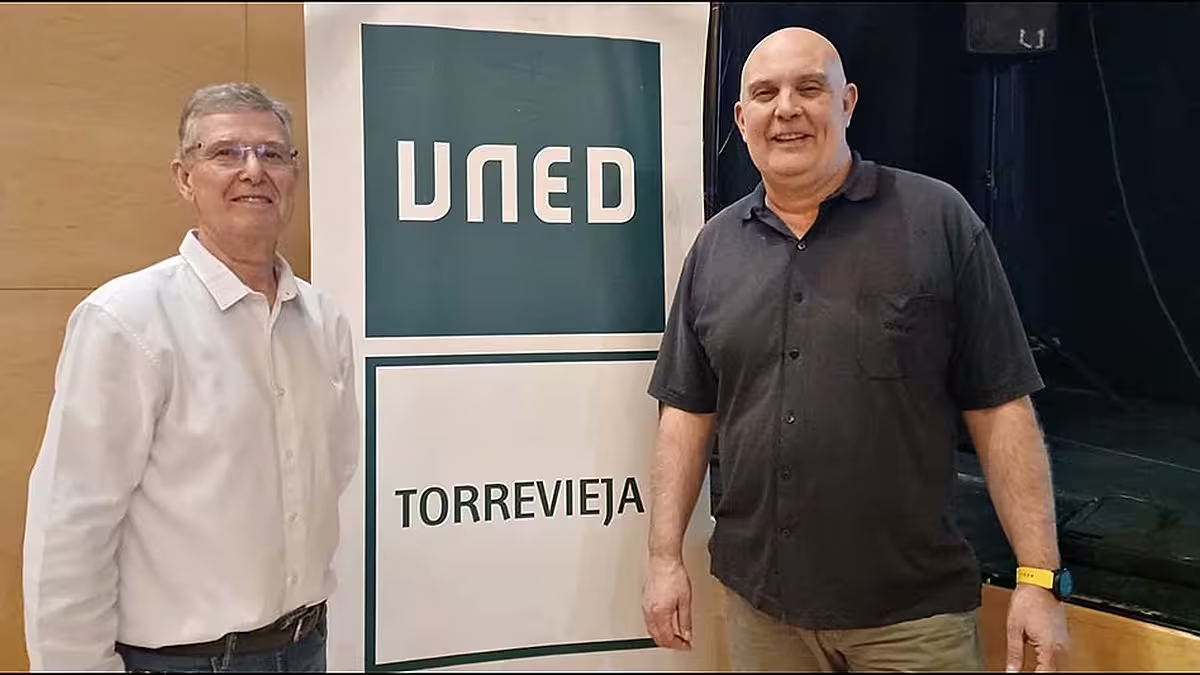
More than 150 people attended a class by Santiago Mallebrera on the builders of the Valley of the Kings at the Virgen del Carmen Cultural Centre auditorium on Monday 19 October. The event formed part of the course on life along the Nile in Ancient Egypt, offered through the Open University for Older People programme at UNED’s Torrevieja centre.
This was the fifth session and the penultimate masterclass in the course. Under the title “The builders in the Valley of the Kings”, the specialist explored the work, knowledge and techniques of those who excavated and decorated the pharaohs’ tombs.
From royal tombs to a community of workers
The content focused on a system of work bringing together excavators, stonemasons, builders, carpenters, draughtsmen and painters. The tombs in the Valley of the Kings, on the west bank of the Nile opposite ancient Thebes, today’s Luxor, were mostly cut into rock. Unlike the great pyramids of the Old Kingdom, their construction involved opening passages and chambers within the mountain.
The session also introduced Deir el-Medina, the settlement where families of specialist workers associated with the royal necropolis lived. Papyri and ostraca, fragments of limestone or pottery used for writing, reveal aspects of their working arrangements, absences and payments in kind.
Planning, excavation and decoration
The exploration of these techniques covered the choice of site, the layout of passages and the adaptation of plans to the condition of the rock. Fractures and variations in hardness required teams to adjust their work as excavation progressed.
Hand tools such as mallets and chisels were used alongside measuring instruments and reference marks to maintain alignment. Removing rubble, lighting the corridors and ventilating the interior spaces were further requirements of working inside the mountain.
Walls were prepared before being decorated with drawings, paintings and reliefs. The duration of each project depended on factors including the tomb’s dimensions, the hardness of the rock, the available workforce and the complexity of the finishes. This coordinated work across different trades was central to the class’s approach to the builders, looking beyond the pharaohs for whom the tombs were created.
Your city, in your inbox.
Useful news and plans for Torrevieja and the surrounding area. Mondays at 08:00 and Thursdays at 18:00 (Europe/Madrid): two emails a week. In English, free and without the noise.
Your choice. Confirm your email and unsubscribe at any time.